2026-09-17
Tread building in precure retreading: what a pressing machine does, and 4 mistakes that open joints
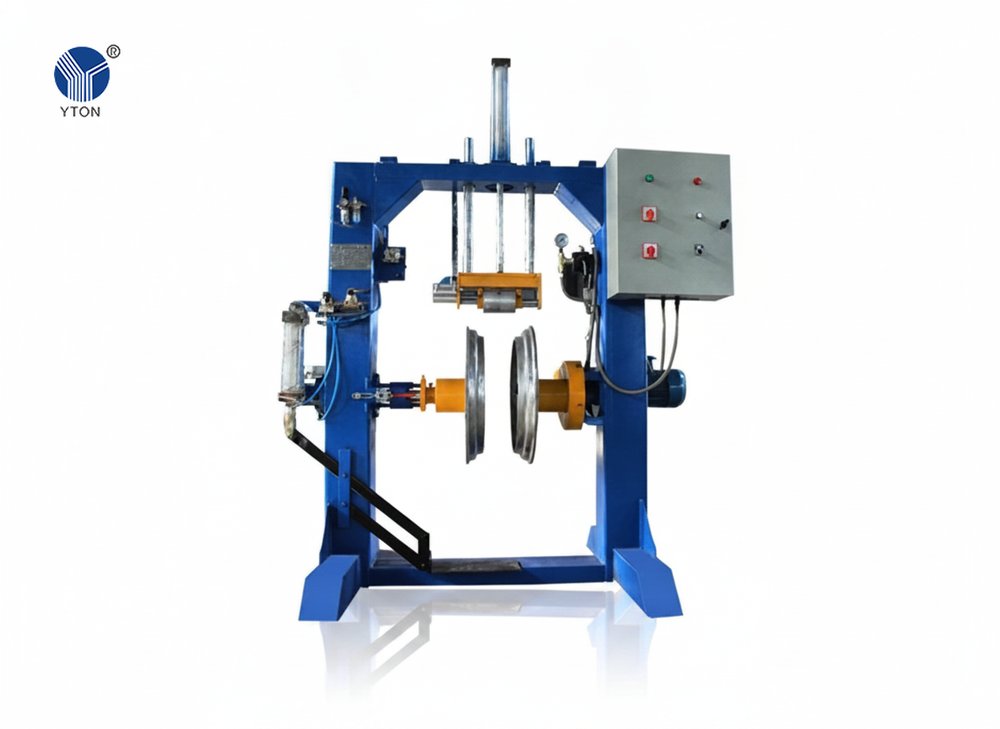
In a precure retreading line, tread building gets the least attention. The pressing machine draws only 1.5 kW and is the cheapest of the main machines. Yet when a retread separates or the tread joint opens on the road, the cause is often found at this step. Here is what a tread pressing (building) machine actually does, and the mistakes we see most often.
What the machine does. The buffed casing, already cemented and covered with cushion gum, is clamped between two rims and inflated so it holds its shape. The operator turns the tyre with a foot switch while a pneumatic roller presses the precured tread onto the casing. After one full turn, the roller slowly spreads outwards from the centre of the tread to the edges, pushing trapped air out to the sides. Tread building has two jobs: put the tread in the right place, and leave no air under it.
Hand stitching vs a pressing machine. Small shops can stitch with a hand roller, but the pressure depends on the operator's arm, it changes around the tyre, and it is hard to work the air out from the centre to the edges. A pressing machine applies the same pressure and speed on every tyre. It takes about 3 minutes per truck or bus tyre, and a new operator can learn it in a few days.
Four common mistakes:
1. Pressing the roller down too hard. This is the number one cause of open joints. Too much pressure stretches the tread; the stretched tread shrinks back, ends up too short and opens at the joint after curing. The roller should just touch the tread. Only for the final air-out pass is it pressed about 1 cm further. 2. Inflating the casing too high. 0.16 MPa is enough. Never go above 0.2 MPa: higher pressure can deform the machine frame. The safety lock must be fully closed before inflating, or the tyre can burst out of the machine. 3. Rushing the joint. Stop about 20 cm before the joint. Cut off the surplus tread, buff both ends, apply cement, and when it is dry apply cushion gum. Align the ends, inch the roller over the joint and roll back and forth about 3 times. 4. Letting the tread drift. Watch both tread edges against the casing shoulders during the first turn. A tread laid off-centre wears unevenly after curing.
Choosing a machine: three questions.
- Which rim sizes? Our YTY-02 gantry pressing machine takes 15", 16", 20" and 22.5" rims. It runs on 1.5 kW with 0.8 MPa compressed air and weighs about 900 kg. It ships fully assembled and test-run: place it on a level concrete floor, connect power and air, and it is ready. - Short of floor space? A gantry press and buff combo puts buffing and pressing on one gantry, saving one station and one tyre transfer. - Do you run the tread-ring process? For ring treads, add the YTYD-01 crown pressing machine, about 2 minutes per tyre.
How many machines? At about 3 minutes per tyre, the press keeps pace with a gantry buffing machine, so one press covers up to about 60 tyres a day. What finally limits the line is curing chamber capacity.
To check whether your tyre sizes fit, email your sizes and daily output to mingtong@yton.cc, or run the plant calculator first: new.yton.cc/en/calculator/.